 The most iconic image of the entire Munich hostage crisis which flashed before cameras and televisions
I was flipping through my movies library today and watched a few minutes of portion of the movie "Munich" when I decided to read more about it on the Internet. It turns out to be a coincidence that today 5th September was the exact day when the Munich massacre happened 38 years ago. If you think the recent failure of the Filipino police force in dealing with the Hong Kong tourist hostage was bad enough, history reminds us the handling of the Munich hostage crisis by the West German authorities was as disastrous. It was the middle of the 1972 Munich Olympics when a group of trained operatives from the militant group Black September, stormed into the Olympic Village in 31 Conollystrasse in the early morning hours to take hostage of the Israeli atheletes residing there. The village security was intentionally lax, following the Germans' determination to change the world's perceptions about them as a result of the bitter taste left by Hitler from the Berlin Olympics in 1936. It was this poor security loophole that was exploited by Black September with great success, starting from the infiltration of the facility as a worker and a mere casual visitor entering the facility without proper identification. They had the blueprint scouted well. Apparently before the games had even started, a West German psychologist, Dr. Sieber had came up with 26 worst case scenarios for the Olympic committee to examing and the predicted situation 21 was eerily too similar to the events that actually tanspired on 5th September. It was however dismissed as being too ridiculous to happen.
On the fateful day, the hostage takers entered into the Olympic Village compound in the most ironic fashion. Quite a number of atheletes had preferred to climb over the fence perimeter to return back to their apartments rather than taking a long detour back to the main gates with the guards. The bunch of them happened to stumbled upon a group of rather drunk group of American athletes who were at the same time, wanting to climb over the fence. Lo and behold, the Americans, unsuspecting of what they were doing or who they were (since all were dressed in tracksuits) helped them to climb over. Once inside and clear from outside eyes, the terrorists removed their AKs from the sports duffel bags and loaded them with bullets. They proceeded in breaking through the doors of the Israeli apartments. Of course, a struggle did occurred between the Israeli athletes and the gunmen as some of them were wrestlers and weightlifters and they thought they had a chance to overpower them with their muscular mass. The struggle did not last long as the gunmen promptly killed 2 of them during the struggle as a reminder to the 9 other sportsmen that they were holding. That was fail number 1 already. Hostage death.
So, the Munich police came in and started negotiations but the problem with the police force is that there were never any elite force or anti-terrorist squad present in Germany that were trained to deal with these types of problems involving highly armed situations. A large part of reason was because of the post-war agreements and the limitations imposed on Germany to operate any of these specialised militaristic group by the Allies. At first they tried storming the building with some track-suited policemen into the compound. Fail number 2: The camera crew were broadcasting the events to worldwide television and this included police positions and movements which the terrorists can observe from their TV sets..lol. Eventually, the storming idea was called off and towards the evening, the negotiations resulted in the terrorists demanding that they be transported via helicopters to the Airport to be flown to Cairo. It was at the airport that most failures were compounded. The Munich police devised another flip flop plan to have policemen dressed as airplane crew in the jet so that they can overpower the terrorist once they are in the plane. They don't seem to be able to make up their minds on a decisive course of action and towards the last minute, they decide to abandon this plan too and adopt another solution, that is to get snipers to take out the terrorists as they walked out of their helicopters. The problem is that there were never any trained snipers in the police team and the handpicked 5 were picked because they had regularly joined weekend competitive game shooting. That's fail number 3. They only had G3 rifles to rely on without scopes or night vision goggles. Fail no. 4. The Munich police had assumed that there were only 5 terrorists and that was the reason why they employed 5 snipers for one head each. Total number of terrorists coming out of the helicopters: 8. Ooopss. Fail number 5. No radio contact between the 5 snipers. Fail number 6. Three were on the control tower and two were on the ground. The two on the ground were vaguely instructed to start shooting as soon as they hear gunfire sounds.
Once the terrorist touched down in the airport, two of them went to inspect the alleged getaway jet plane and when they discovered that it was empty, they started running back in panic to tell their other comrades that their positions were compromised already. It was at this point that the German "snipers" started to open fire, killing two terrorists and fatally wounding another. The others managed to get away and ducked for cover. A firefight followed afterthat and this was proceeded by an hour of so of standoff, terrorists still hiding in the airport runway vicinity and giving sporadic shots once in a while. The terrorists succeeded in shooting out most of the airport lights and in the moment of confusion and darkness, friendly fire meant that that the 2 snipers on the ground were mistakenly targetted by their colleagues on the control tower, reducing the amount of operational sharpshooters to 3 personnels. Fail no. 7. The situation would have been easily settled with the deployment of armoured personnel carriers but the APCs were deployed only after the gunfight occured. And then they were stuck in a traffic jam. Epic Fail no.8. So, it finally ended with the remaining terrorists going on a kamikaze run towards the helicopters, spraying bullets and killing all hostages under point blank AK -47. To finish off the job, the terrorists lobbed grenades to explode the helicopters, burning the corpses in the process before they themselves were shot dead by the police. All hostages died at the end of the day. GG.
Up till today, the Germans could never account for their tactical failure in dealing with the crisis. It was a doomed rescue operation from the start, with many basic mistakes being made that could have saved lives. The West German government responded by forming the elite commando Swat group of GSG-9. Security at the Olympic Games was never compromised since then. Munich spent less than $2 million for security. The security bill in Athens 2004 was estimated to be more than $600 million. History does teach lessons in the end. Both sides did not gain at the end on what they had demanded, although one could say that it was a political statement success for the Palestinians in a way since they were brought under focused world media attention after the incident.

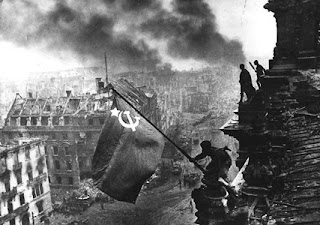 Soviet Victory over Berlin - A Soviet trooper climbs up the Reichstag to plant the USSR flag, a symbolic action marking the fall of the Nazi regime and the start of a tumultuous struggle between two superpowers for the control of the city for the next 45 years.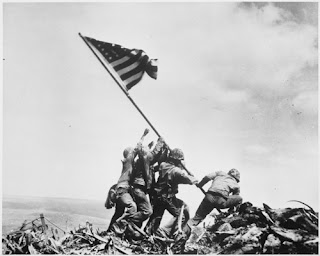
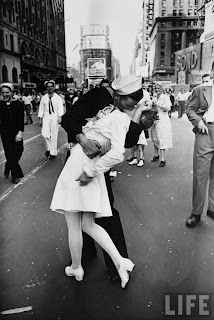 Victory over Japan Day - One of my personal favourites. This shot was taken from Times Square in New York, on the day of announcement that war is over.
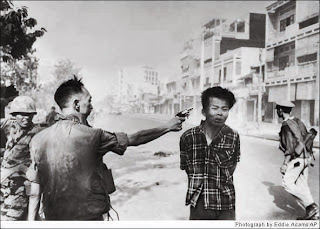
 Afghan Girl refugee - The piercing green eyes graced the cover of the National Geographic magazine in the 80s to highlight the plight of refugees all over the world. The identity of the girl was found by the photographer 20 years later.
  Tiananmen Square 1989 - The sight of a young man defying the rolling war machine speaks volume of the university students who demanded democratic reforms during that year.
 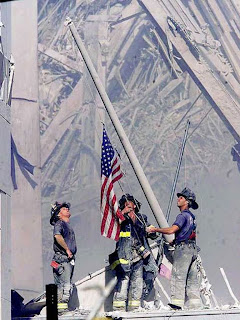 World Trade Center 9/11 - The raising of the flag by the firemen was reminiscent of the photo from Iwo Jima. The paradigm of world politics had a major shift eversince that day.


